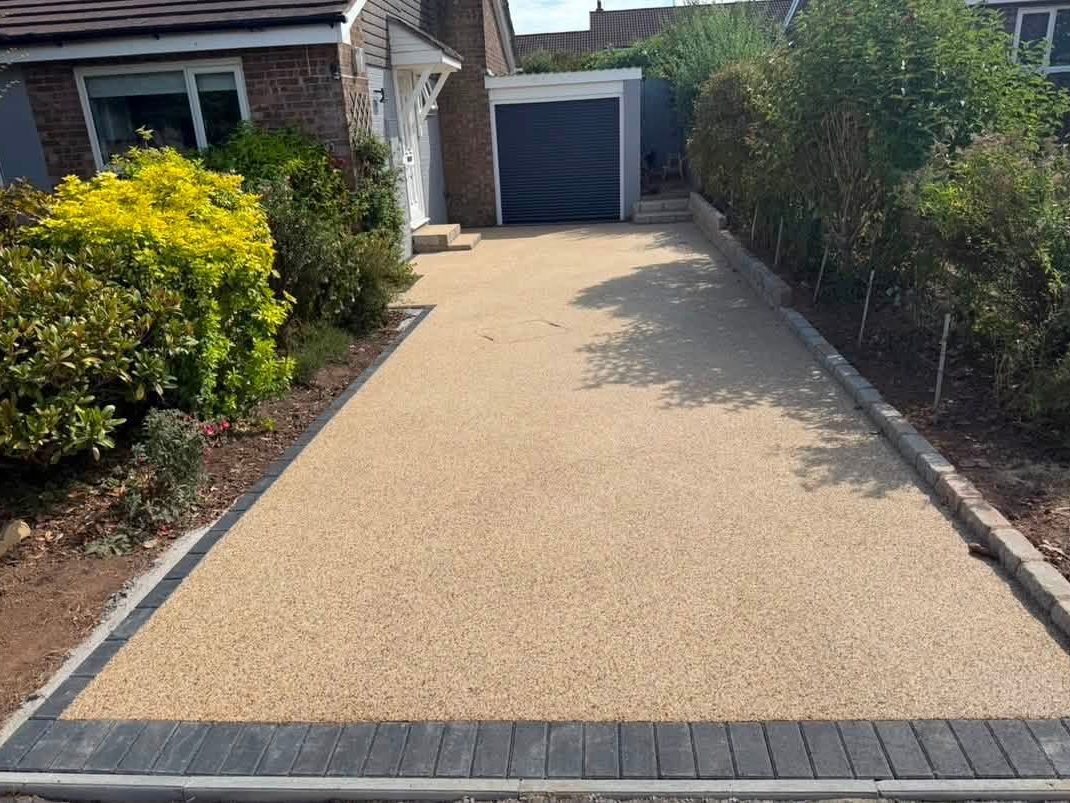
Resin bound stone gives you a smooth, seamless, permeable surface with no loose gravel to kick about and no joints to weed. It is only as good as what it goes on, so the base matters as much as the finish: a sound tarmac or concrete base, or a new one built for it, then the aggregate and resin mixed on site and trowelled out.

Resin bound is a surfacing, not a construction. It needs a stable permeable base, usually new open graded tarmac or a sound existing one. We check what you have, and if the honest answer is that the existing base will telegraph every crack through the finish, we say so before you spend the money.
Aggregate and UV stable resin forced mixed on site in measured batches, then laid and trowelled to a consistent depth while it is live. Consistency of batch and pace is what stops a resin drive looking patchy, which is why it is not a job to rush or to leave half done.
A correctly laid resin bound surface lets water through the surface into the base rather than running it into the road, which is what keeps most driveways outside the planning conditions on hard surfacing. It also means no puddles and no standing ice in the same spot every winter.
Natural gravels, golden quartz, silver granite and blends in between, with samples to look at against your house rather than off a screen. Edging can be block, kerb or an aluminium trim depending on whether you want the drive framed or seamless.
No. Resin bound is every stone coated in resin and trowelled into a solid, smooth surface, so nothing migrates onto the pavement or into the house. Resin bonded, a different product, is loose stone scattered onto a resin layer and does shed. When we quote resin, we mean resin bound.
If the existing surface is sound tarmac or concrete with the right falls and no significant cracking or movement, yes, and it makes for a quick job. If it is block paving, badly cracked concrete or a failed base, the base has to be dealt with first. We will tell you which after we have looked.
Where a good base already exists, the resin itself is often a single day for a typical drive. Where a new base is needed the job runs to three to five days in total. It needs dry weather and a temperature above roughly five degrees to cure, so it is genuinely weather dependent.
Foot traffic after around six hours in decent conditions, and vehicles after a full twenty four to forty eight hours depending on temperature. We give you the real figure on the day, because pushing it is how the first tyre mark ends up permanent.
Very little. An occasional wash down and keeping leaves and moss off it in a shaded spot is about it. There is no jointing sand to top up and no loose stone to rake, which is the main reason people move to it from gravel.
Based at New Street in Salisbury and working up to 100 miles out across Wiltshire, Hampshire, Dorset, Somerset and Berkshire, so a look at your job is rarely more than a couple of days away.
Send a photo or two through WhatsApp, or ring us, and we will come out and give you a free written estimate.